The relief rally has passed its first credit test
The US equity rebound now has more support than price alone.
The latest dated US high-yield spread eased to 3.42% on November 6 from 3.48% one session earlier. In the current snapshot, 70 of 100 sampled US stocks are above their long-term averages, while the VIX has fallen to 20.24. Together, those readings weaken the immediate case that the earlier equity shock was spreading into a broad funding break.
The mechanism matters. Lower credit spreads imply that weaker companies are not facing a rapidly rising market-wide risk premium, while stronger breadth shows that the rebound extends beyond a narrow group of index leaders. That combination is more credible than an index bounce unsupported by financing conditions.
This is still a relief signal, not an all-clear. Estimated positive dealer gamma fell sharply from its previous reading, leaving a thinner mechanical buffer against renewed volatility. High-yield spreads also remain above the 3.32% level recorded before the November 5 shock.
The next test is persistence. Further spread compression alongside stable breadth would strengthen the case that the shock is being absorbed. Renewed spread widening, especially above 3.50% while breadth deteriorates, would reverse that conclusion.
Hy Spread
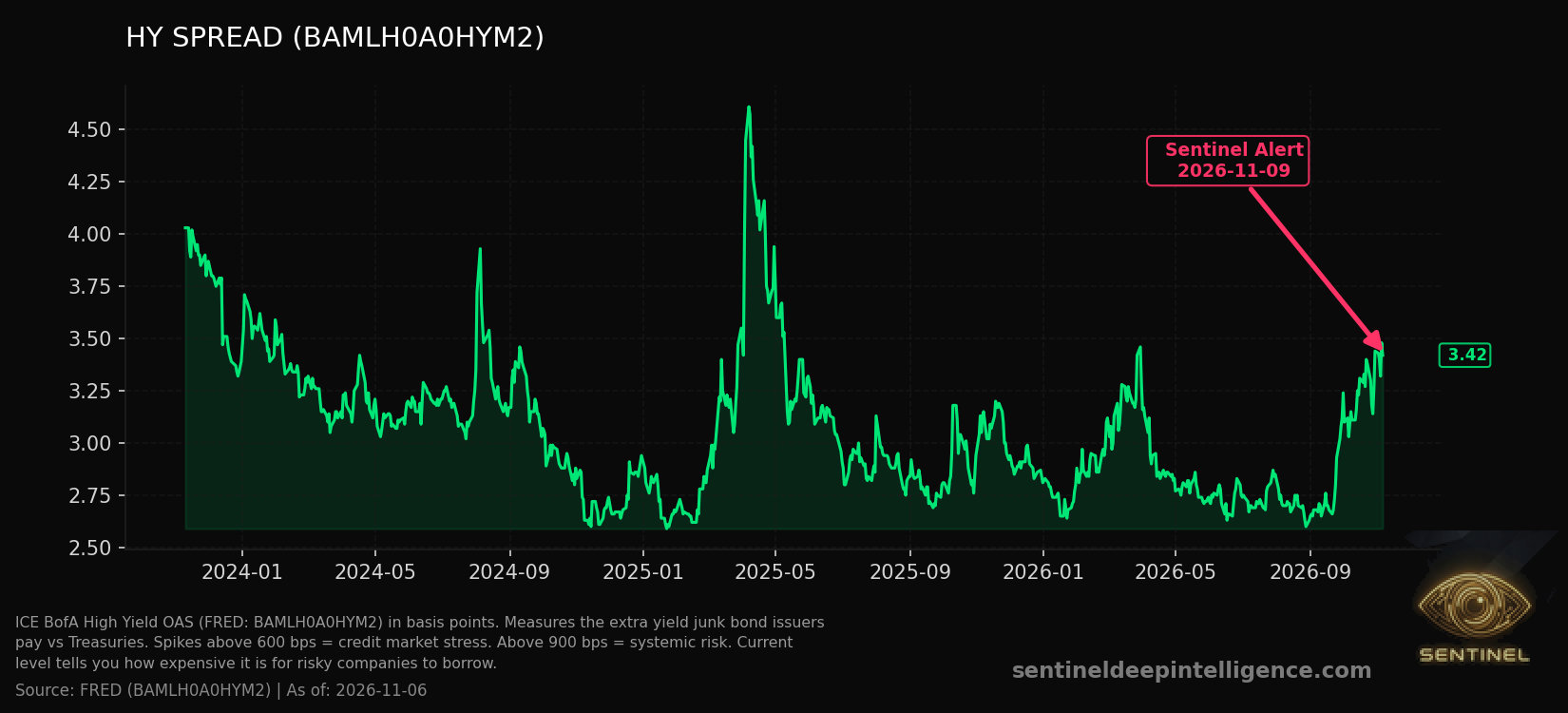
ICE BofA High Yield OAS (FRED: BAMLH0A0HYM2) in basis points. Measures the extra yield junk bond issuers pay vs Treasuries. Spikes above 600 bps = credit market stress. Above 900 bps = systemic risk. Current level…